
How Utilities Are Using Cloud ERP to Improve Tax Workflows
Why Cloud ERP for Utilities?
Costs are rising, and tax rules are becoming more complex. This makes utility companies rethink how they handle their back-office work. Old tax systems, often run with separate systems and manual steps, can't keep up with today's rules. Especially since 95% of organizations are interested in running ERP (Enterprise Resource Planning) in the cloud.
Switching to cloud ERP systems is more than just a tech upgrade for utilities. It's a big change that puts all enterprise data in one place, automates tax work, and lets companies see their true financial and managerial position in real-time across different areas.

Cloud ERP for utilities represents a fundamental shift from fragmented, spreadsheet-driven tax workflows to integrated, automated systems that connect financial data with operational realities. The role of ERPs in corporate tax digital transformation shows how leading organizations are leveraging these platforms to eliminate manual errors and reduce compliance costs.
The transformation is about reimagining the tax teams’ collaboration with finance, operations, and tech teams. When tax provision processes integrate seamlessly with real-time operational data, utilities gain unprecedented visibility into previously unclaimed deductions and streamline reporting across multiple jurisdictions.
Understanding how cloud ERP systems specifically address utility tax challenges reveals why this integration has become essential for competitive operations.
Understanding Cloud ERP and Tax Workflow Integration
Cloud ERP systems represent a fundamental shift from traditional, siloed tax management approaches. Unlike legacy systems that require manual data transfers and disconnected processes, cloud-based ERP platforms create unified data environments where tax, finance, and operations teams access shared information in real-time.
For utilities, this integration addresses a critical pain point: the complex interplay between asset management, regulatory compliance, and tax obligations. When asset data flows automatically from operations into tax calculations, utilities eliminate manual reconciliation processes that historically consumed hundreds of hours annually.
The Technical Debt Problem
Here's what happened over the past decade: IT teams bolted-on tools on top of legacy ERP systems for tax teams. These systems worked, they kept operations running while core ERP systems aged.
But now, as utilities migrate to next-generation cloud ERP platforms, all that technical debt must be evaluated. Every bolt-on application faces a critical test: Does this perform a mission-critical function that the new system genuinely can't handle? Or should this functionality be consolidated back into the core system?
For specialized tax applications, that evaluation is existential. The ones that can't demonstrate clear differentiation get axed, as indicated by the most recent downturn in sentiment for corporate software companies in public equity markets. The ones that survive need to prove they're solving problems the ERP or AI can't.
Key Benefits of Cloud ERP in Utility Tax Workflows
The benefits of cloud ERP for tax management extend far beyond simple automation, creating a foundation for strategic tax operations. Modern platforms improve tax workflows and eliminate the data silos that traditionally plague utility tax departments. This enables real-time visibility into asset lifecycles, depreciation schedules, and regulatory compliance requirements across multiple jurisdictions.
Standardized Data Collection
Standardized data collection represents perhaps the most transformative benefit. Where tax teams previously tracked deductions and exemptions manually through spreadsheets, cloud ERP systems capture this information systematically. In our experience at Lucasys, automated workflows can reduce manual intervention by 60-80% while improving data accuracy.
However, not all cloud ERP solutions handle tax the same way. Most platforms process tax through batch reconciliation. Monthly or annual processing cycles that require manual review and adjustment. This creates the familiar workflow pattern utilities have lived with for years:
Asset data lives in the operational system
Finance runs month-end close
Tax pulls data from finance at a month-end, quarter-end, or year-end
Tax manually reconciles discrepancies
Tax processes calculations offline
Tax uploads results back to the system
Real-Time Processing vs. Batch Reconciliation
This is where specialized tax systems like Lucasys differentiate themselves from both legacy systems and generic ERP solutions. By processing records as they're integrated rather than in monthly batches, utilities eliminate the reconciliation cycles that consume hundreds of hours annually. Instead of waiting for the month-end close, tax calculations occur in real time as asset transactions flow through the system.
The integration capabilities also address the unique complexity of utility operations. From property tax assessments on transmission lines to sales tax exemptions on capital equipment, specialized systems maintain audit trails that satisfy both internal controls and regulatory scrutiny. While utilities typically recover up to 15% more in eligible deductions through improved visibility into previously unclaimed items.
Real-World Impact: Efficiency and Cost Savings with Lucasys
The measurable benefits extend well beyond theoretical improvements. With over two dozen engagements with American investor-owned utilities undergoing cloud ERP transformation, we saw a pattern: When tax stakeholders integrated early with finance and operations teams to articulate key upstream dependencies, standardized information collection replaced manual offline tracking.
The results were substantial:
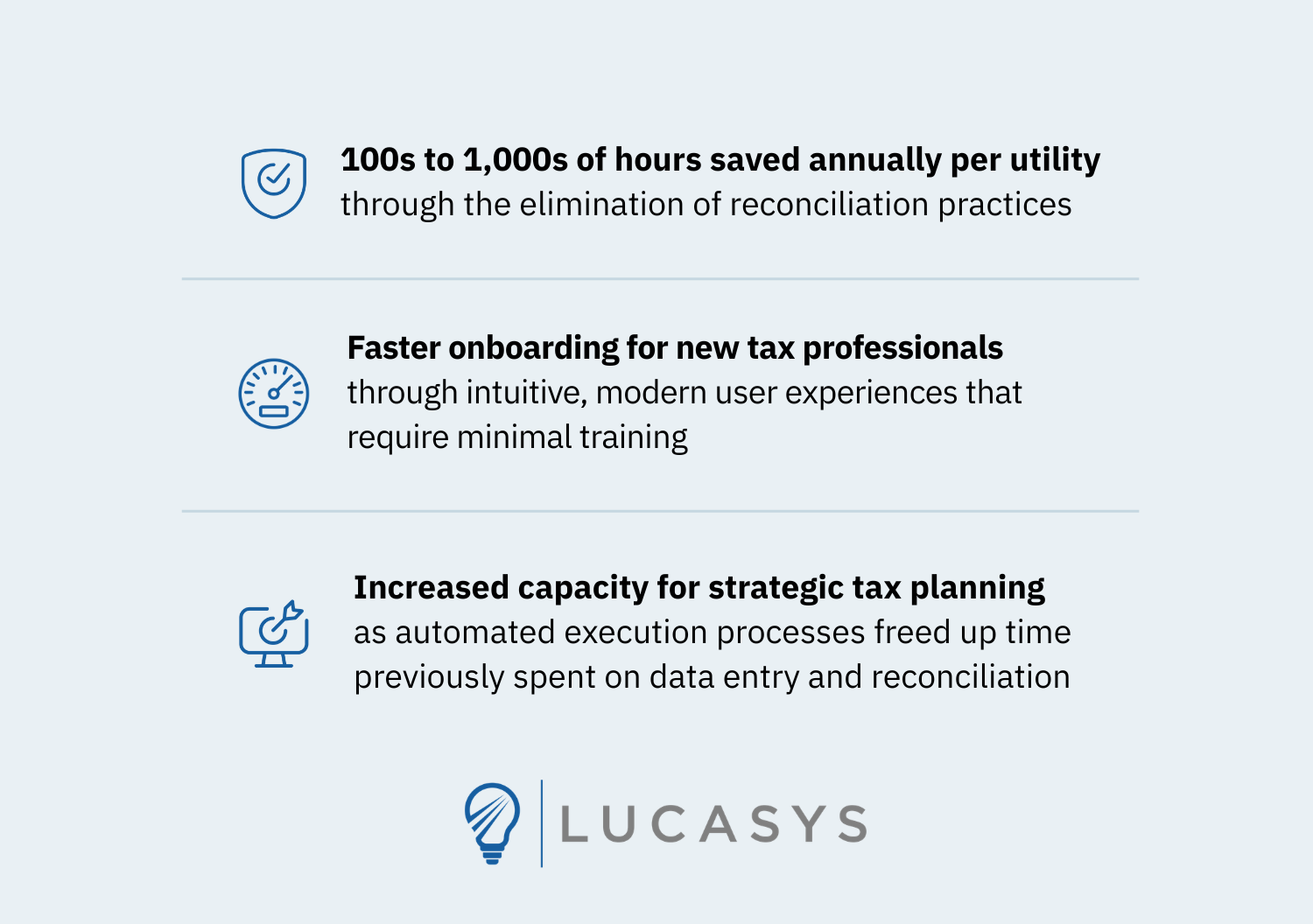
Hundreds to thousands of hours saved annually per utility through the elimination of reconciliation processes
Faster onboarding for new tax professionals through intuitive, modern user experiences that require minimal training
Increased capacity for strategic tax planning as automated execution processes freed up time previously spent on data entry and reconciliation
A Note About User Experience
Modern tax professionals joining utilities today expect software that works like the tools they use outside work: with intuitive interfaces and logical workflows. When your onboarding process requires weeks of specialized training, it becomes more of a headache for the teams involved in the implementation. In turn, it becomes more difficult to adopt, which could result in higher reliance on IT teams for the long term.
When software is user-friendly, it relies less on the IT team for tax-related work. This matters not just for productivity but for the strategic positioning of the tax function. Systems that automate routine execution create capacity for strategic work.
Challenges in Implementing Cloud ERP Systems
Despite compelling benefits, cloud ERP implementation presents distinct hurdles that utilities must navigate carefully. Data migration complexity tops the list of concerns, as utilities often maintain decades of tax records across multiple legacy systems that require careful translation and validation during the transition process.
Integration challenges make these hurdles even more complex, particularly when connecting cloud ERP platforms with existing utility-specific applications for meter data management, outage systems, and regulatory reporting tools. Organizational change management represents another critical barrier, as tax teams must adapt to new workflows while maintaining accuracy during busy filing seasons.
Resource allocation creates additional pressure points, with utilities needing to balance implementation costs against ongoing operational demands. Training requirements can strain already-lean tax departments, while customization needs often extend project timelines beyond initial estimates.
Strategies to Overcome Implementation Challenges
Successful cloud ERP deployment requires a structured approach that addresses utilities' unique operational requirements. Establishing clear project governance with dedicated tax stakeholders participating throughout the implementation process proves essential.
Phased Rollouts and Parallel Testing
Utilities can mitigate data migration risks by implementing phased rollouts, starting with non-critical systems before transitioning core tax functions. Testing parallel systems during implementation allows utilities to identify integration issues before full deployment, ensuring tax workflow solutions maintain accuracy while transitioning to cloud-based platforms.
Comprehensive user training and robust data validation protocols during the transition period make ERP tax automation more reliable. Organizations that provide adequate support during the learning curve see faster adoption rates and reduced implementation costs.
The Integration Point
Tax stakeholders should always be at the table when the ERP implementation team is mapping data flows.
When tax requirements are treated as an afterthought, utilities end up rebuilding the same manual processes they were trying to eliminate. But when tax teams articulate their upstream dependencies during the design phase, those data flows get built into the system architecture. The ERP knows which asset transactions have tax implications. The asset management system knows which data elements tax needs. The procurement system knows which purchases qualify for exemptions.
The "Lean Into Your Strengths" Strategy
Lucasys focuses on what we do best: tax for capital-intensive businesses, and does it at a level that general-purpose ERP systems can't match.
When utilities evaluate which applications survive the cloud ERP migration, they're not looking for systems that duplicate ERP functionality. They're looking for specialized tools that deliver clear value the ERP can't or won’t provide, especially as ERPs view US tax as a localization issue rather than part of their core business of selling software.
This is how specialized tax systems prove their worth during the mission-critical evaluation: By seamlessly integrating with Oracle and SAP while remaining true to their core competencies. Lucasys allows the ERP to handle what it does best while delivering a premier experience for the tax complexities unique to capital-intensive utilities.
The Future of ERP Systems in the Utility Sector
The trajectory of cloud ERP adoption in utilities points toward increasingly sophisticated automation and intelligence. Emerging technologies like AI and machine learning are being integrated into enterprise-level platforms, promising even greater efficiency gains in tax workflow management through predictive analytics for tax planning and automated compliance monitoring.
The convergence of regulatory requirements and technological capabilities will continue driving innovation in utility tax workflows, making comprehensive digital transformation not just advantageous but essential for competitive positioning. As the utility sector continues evolving toward greater automation and intelligence, cloud ERP systems will become increasingly sophisticated in handling complex tax scenarios and regulatory requirements, making early adoption a competitive advantage for forward-thinking utilities.
Key Takeaways
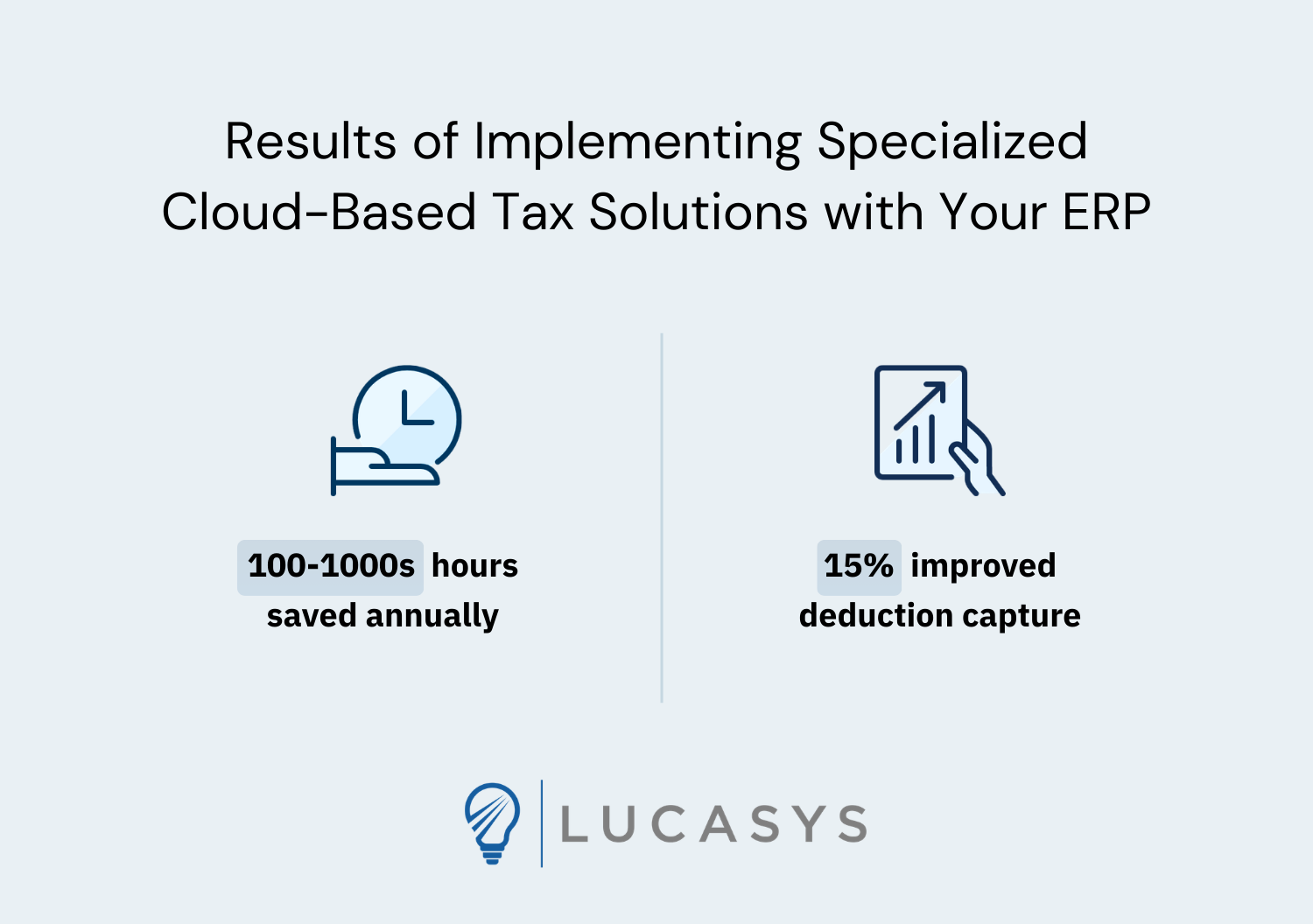
Cloud ERP transformation represents a fundamental shift in how utilities manage tax operations, moving from fragmented manual processes to integrated, automated workflows. The evidence is clear: utilities that implement specialized cloud-based tax solutions alongside their core ERP systems typically achieve hundreds to thousands of hours of annual time savings and improve deduction capture rates by up to 15% through enhanced visibility into previously unclaimed items.
The standardization of data collection emerges as perhaps the most critical success factor. When tax stakeholders integrate effectively with finance and operations teams during ERP implementation, utilities can articulate key upstream dependencies that eliminate manual offline tracking. This coordination ensures accurate, real-time tax data flows throughout the organization.
However, successful implementation requires careful attention to change management and stakeholder alignment. The transformation touches multiple departments and processes, making cross-functional collaboration essential. Organizations that invest in proper planning, training, and gradual rollouts consistently outperform those rushing implementation.
Most importantly, utilities must critically evaluate which specialized tax applications survive the transition to next-generation ERP. Systems that merely digitize existing manual processes will be consolidated back into the core ERP or outsourced. Systems that deliver mission-critical functionality: real-time processing, intuitive user experiences, and demonstrable ROI through time savings or improved deduction capture, will remain essential components of the modern utility tax technology stack.

Ready to see how real-time tax processing works in practice? Book a demo to explore how Lucasys handles the specific complexities of utility tax workflows while seamlessly integrating with your cloud ERP platform.
Visit our website and explore the Lucasys Tax Suite at www.lucasys.com.