
What does “Lucasys” mean?
If you have ever seen the Lucasys team at an industry conference or somewhere online, chances are you have tried to pronounce the company name and wondered where to put the emphasis. Here is your cheat sheet and cliff-notes version of the origin story. Not only will it help you remember how to pronounce the name, but it will also give you a better understanding of the foundation we were built on. And if you know our team, it will come as no surprise that there is deep meaning behind the name- it was designed with purpose.
The two parts of the name Lucasys – Luca and systems – come from 3 ideas that intersect in our work.
1.“Luca” is the founding father of double-entry accounting
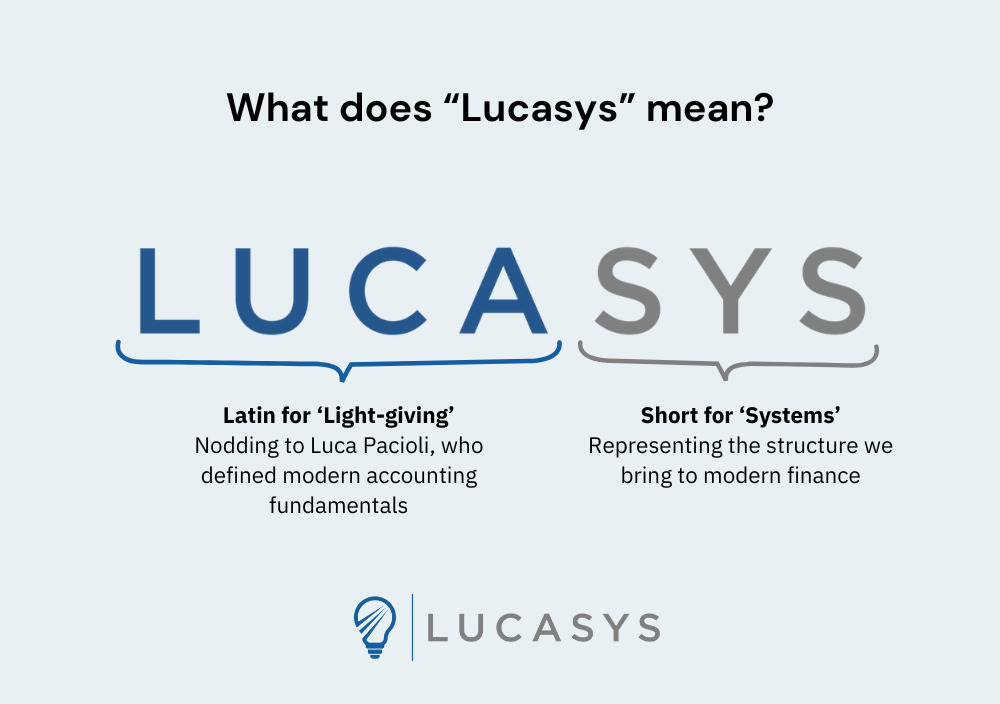
In 1494, Italian mathematician Luca Pacioli documented the principles of double-entry accounting. This created a structured, reliable way to record financial transactions. They could be checked, validated, and trusted. And that foundation is still in use today.
At Lucasys, that idea – always going back to fundamentals – is what matters.
While finance organizations today are more complex than ever with more data, more systems, and more pressure to move quickly, we see firsthand that the need for clear fundamentals hasn’t changed. If anything, it’s more important.
2. “Luca” also means “light-giving”
Going deeper into the name “Luca” in Latin is “Lucas” and Greek “Loukas.” It means “bringer of light” or “light-giving.” Which is why we have the lightbulb in our logo. Following the complexities created by the TCJA reform in 2017, we wanted an ever-present reminder that Lucasys, as a team, brings the principle of light and clarity into everything we build and do for our customers.
3. “Sys” is short for “systems”
The second part of the name is systems to name the structure that Lucasys brings to the modern finance environment.
The same principles that made double-entry accounting reliable in the 1400s can still guide the design of financial systems today.
The innovation is how those principles are applied through modern technology.
Through technology, automation, and thoughtful system design, we help organizations create environments that are not only audit-ready but also usable day-to-day. Systems that support better decisions and reduce friction.
We most commonly see issues around:
Disconnected data flows between legacy systems and upstream/downstream systems (ERP, fixed assets, regulatory reporting tools).
Manual workarounds that creep in over time, increasing risk and reducing confidence in tax calculations.
Limited transparency and auditability, especially when data transformations aren’t well-documented.
Performance constraints as data volumes grow, particularly for large utilities with complex asset portfolios.
Lucasys adds meaningful value to systems, bringing structure, automation, and sustainability to the ecosystem.
We do that by:
Designing clean and scalable data pipelines that ensure accurate, timely, and reconciled data.
Eliminating manual processes through automation and integration, reducing risk, minimizing expenses for external consultants, and improving overall efficiency.
Implementing scalable architecture that can handle growth without degrading performance.
Enhancing traceability and controls, so tax teams have full confidence in their outputs and are always audit-ready.
How can we help you?

And that three-fold foundation serves as the guiding light to what Lucasys continues to build.
We believe that strong foundations and user-friendly structures will give finance a more strategic and impactful role within the business, no matter the legislative changes or added layers of complexity in their data.
Enterprise tax professionals can go beyond reporting on what happened and into helping shape what happens next.
If you would like to get in touch with a Lucasys expert to begin your journey through a tax technology transformation, you can schedule time with us here: https://www.lucasys.com/demo.
Recent News: Lucasys Enters New Year with 30 Total Customers, including 7 New Customer Subscriptions