
Why oil & gas tax teams are rethinking their fixed asset platform
If you're a tax leader at an oil & gas company, you already know the math: pipelines, processing facilities, storage terminals, and upstream assets add up fast. A single midstream operator can carry tens of billions in gross PPE, spread across dozens of jurisdictions, each with its own depreciation rules, repairs treatment, and reporting deadlines.
What you may not know is that the tax platforms originally built for regulated utilities, the most depreciation-intensive industry in North America, are increasingly being adopted by oil & gas companies facing the same fundamental problem at a similar scale.
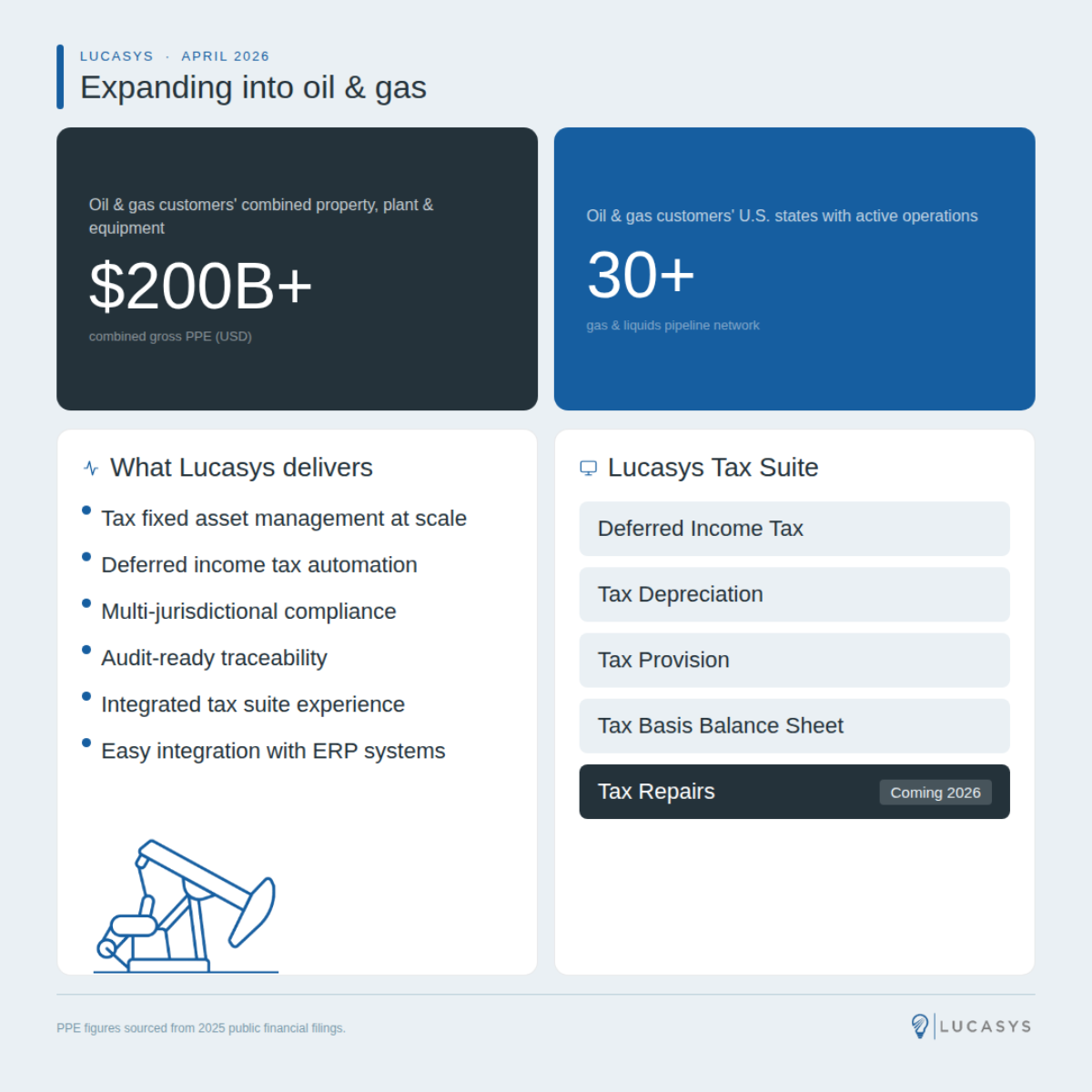
This week, Lucasys announced that multiple oil & gas companies have subscribed to the Lucasys Income Tax Suite. The new customers collectively manage more than $200 billion in property, plant, and equipment across North America, with operations spanning more than 30 U.S. states and Canada. For tax teams at asset-intensive energy companies, the announcement is less about Lucasys and more about a quiet shift in what "good" looks like for fixed asset tax software.
The problem isn't unique to utilities
For decades, regulated utilities have driven the most demanding requirements in tax fixed asset management. Long asset lives, mass property pooling, repairs analysis, deferred tax tracking down to the work order, and audit trails that hold up to FERC and state commission scrutiny have all shaped a category of software that few other industries needed.
That's changing. Today's oil & gas operators face a strikingly similar set of pressures:
Massive, geographically distributed asset bases that span pipelines, gathering systems, storage, and processing across many tax jurisdictions
Complex depreciation schedules with bonus, MACRS, ADS, and book-tax differences that compound across thousands of asset records
Deferred tax accuracy requirements that drive both financial reporting and rate-case-style economic analyses for partners and investors
Audit exposure that grows with every acquisition, divestiture, and reorganization
The methodology that solved these problems for utilities turns out to transfer cleanly. The complexity differs in shape but not in scale.
What changes when the platform is built for the workload
Most oil & gas tax teams today operate on some combination of legacy fixed asset systems, spreadsheets layered over ERP exports, and homegrown tools that have grown organically over years. Each has its place. But at a certain asset count, the cracks show. Reconciliations stretch longer. Audit questions take days instead of minutes. Provision close becomes a sprint rather than a process.
A platform purpose-built for high-volume tax fixed asset management changes the day-to-day in three measurable ways:
Speed of close. Automated tax depreciation calculations and deferred income tax roll-forwards eliminate the manual reconciliation steps that consume the back half of every quarter.
Audit readiness. Every calculation traces back to its source data, its rule, and its point in time. When an auditor asks "why," the answer is one click away, not a week of forensic work in spreadsheets.
Confidence in the numbers. When the same engine handles depreciation, deferred income tax, tax basis balance sheet, and provision, the inconsistencies that plague multi-tool environments simply don't appear.
Why this matters now
Oil & gas tax departments are under more pressure than they have been in years. Bonus depreciation phase-down, ongoing repairs guidance, the prospect of new tax repairs methodologies, and continued M&A activity all increase the surface area of complexity. At the same time, finance organizations are being asked to do more with leaner teams.
The companies adopting Lucasys aren't doing it for novelty. They're doing it because the alternative, running a $20B+ asset base on tools designed for a fraction of that complexity, has become a real risk. Misstatement risk, audit risk, and the operational risk of a key person leaving and taking institutional knowledge with them.
The takeaway for tax leaders

If your fixed asset tax process feels like it's straining at the seams, you're not alone, and you're not stuck with the tools you have. The same platform now trusted by leading utilities and a growing roster of oil & gas operators is built for exactly the kind of complexity your team navigates every quarter.
The question worth asking isn't whether your current setup works. It's whether it will still work in two years, with more assets, more jurisdictions, and a leaner team.
For oil & gas tax leaders evaluating that question, Lucasys is worth a conversation.
Learn more about the Lucasys Income Tax Suite at lucasys.com, or schedule a demo to see how it fits your environment.