
Lucasys Blog

Once Is Enough
At Lucasys, we understand that your time is one of your most valuable resources. That’s why we’ve built our systems to ensure that the work you’ve done in prior periods is preserved—even as new data is added or processes are updated.
The Lucasys software is designed to seamlessly integrate new information, such as additional budget data or actuals for new months, without overwriting or losing prior period adjustments. Using Incremental and Merge import options, you can update your data while retaining all topside or manual adjustments from earlier periods.
What Utilities Can Learn from Macy’s Accounting Error
Macy’s recent disclosure of an employee’s intentional misreporting of up to $154 million in expenses has sparked important conversations about internal controls, accountability, and transparency. While the retail giant is navigating this challenge, there are key lessons for businesses across all industries, including utilities, where accurate financial reporting is not just critical but also highly scrutinized by regulators.

The Future of Finance and Technology: How Utilities Can Lead the Digital Transformation
As utility companies face increasing pressures from regulatory demands, shifting energy landscapes, and evolving customer expectations, the importance of digital transformation has never been greater. The intersection of finance and technology is opening new avenues for operational efficiency, data-driven decision-making, and streamlined business processes. For utilities, which operate in complex, highly regulated environments, this presents a unique opportunity to lead the way in digital transformation while securing long-term growth and sustainability.

Strategy and the Role of Tax
I’m reading a book, Strategy That Works by Paul Leinwand and Cesare R. Mainardi ], because, of course, that’s what you do when you are semi-retired. As I read, I reflected on how strategy at most utility companies is directed at becoming more efficient and more effective operationally while finding a way to otherwise reduce costs to offset continuing customer rate pressure. The tax department’s role today generally has 2 components both related to cost savings: (1) deliver tax savings that lower tax expense for the company or tax costs recoverable in rates, and (2) deliver costs savings from operating more efficiently.

Mastering ASC 740: Best Practices for Utility Companies
ASC 740, or Accounting Standards Codification 740, governs how companies report income taxes in their financial statements. For utility companies, complying with ASC 740 presents unique challenges due to the industry's complex regulatory environment and the intricate nature of tax provisions, deferred taxes, and rate-regulated accounting practices. Mastering ASC 740 is essential for ensuring accurate financial reporting, mitigating risk, and satisfying both regulatory and audit requirements.

Preparing for Regulatory Scrutiny: Tax Compliance in the Utility Sector
In today’s rapidly evolving regulatory landscape, investor-owned utilities (IOUs) face increasing pressure to ensure their tax practices are not only compliant but also transparent and defensible. With the growing scrutiny from regulators and the ever-changing tax laws, staying ahead of potential audits is more critical than ever. To navigate these challenges, IOUs must implement robust strategies for tax compliance, leveraging advanced tools and technologies that can simplify the process and mitigate risks.
Understanding the Tax Implications of Mergers and Acquisitions in the Utility Sector
Mergers and acquisitions (M&A) have long been a strategic tool for growth and expansion in the utility industry. Whether to achieve economies of scale, expand service territories, or diversify energy portfolios, these transactions can significantly reshape a company's operations and market position. However, along with the potential benefits, M&A activities come with complex tax implications that can have a lasting impact on a company's financial health and regulatory compliance.
Navigating Tax Challenges in a Multi-Jurisdictional Utility Operation
For investor-owned utility companies operating across multiple states, managing tax compliance is a complex and often daunting task. Each state has its own set of tax laws, regulations, and reporting requirements, which can create a labyrinth of obligations for utility tax departments. In this environment, staying compliant while optimizing tax positions requires not only deep expertise but also the right tools and technology.
Navigating the PowerTax End of Life: What Utilities Need to Know and How to Transition Smoothly to Lucasys Tax
As a utility company, you rely on robust, reliable software to manage complex tax processes efficiently. For decades, PowerPlan’s PowerTax software has been the only available industry-focused tax fixed asset solution. However, the Lucasys team has heard from many utilities that PowerPlan has communicated an End of Life for its PowerTax software. If your organization has been told that PowerTax is reaching its End of Life, you may now be facing the urgent task of finding a new solution to replace your legacy solution. The discontinuation of any software poses significant challenges, but it also presents an opportunity to upgrade to more advanced, future-proof technology like Lucasys Tax.
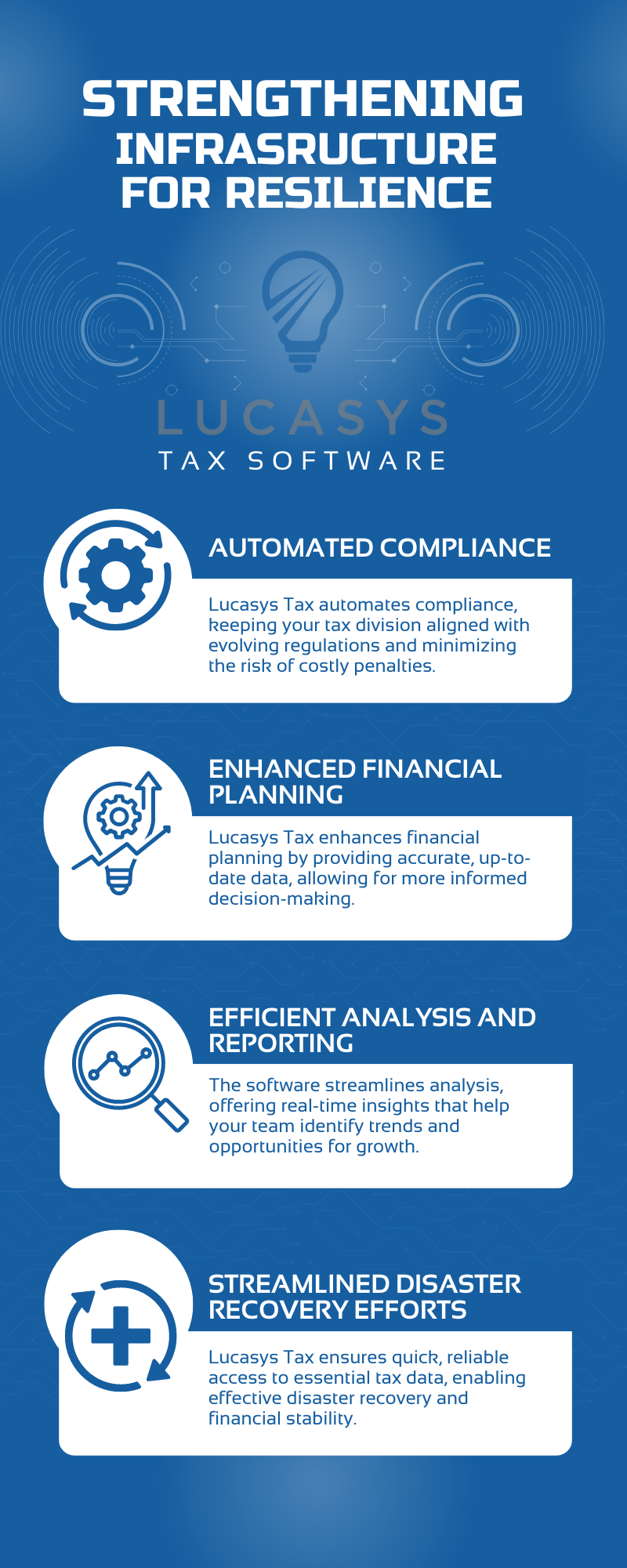
Strengthening Infrastructure for Resilience: The Crucial Role of Tax Software in Investor-Owned Utility Companies
As climate change accelerates, extreme weather events are becoming increasingly common, posing significant challenges to utility companies across the globe. Investor-owned utilities (IOUs), responsible for providing essential services to millions, are at the forefront of efforts to strengthen infrastructure and ensure resilience against these threats. While physical upgrades and operational strategies are crucial, one often-overlooked aspect of this resilience is the role of a utility’s tax division and its technology. Robust tax management is vital in funding, maintaining, and expanding resilient infrastructure.
Corporate Tax Rate Changes on the Horizon… Again! What Utilities Need to Know
As the 2024 election season gains momentum, regulated utilities are facing the prospect of significant policy shifts that could dramatically impact their financial landscapes. Vice President Kamala Harris has recently announced that if elected, she plans to raise the corporate tax rate to 28%. This proposal has raised alarms among tax leaders and CFOs within the utility sector, as the potential changes could lead to substantial adjustments in deferred tax liabilities.

Summit Utilities Partners with Lucasys to Streamline Tax Fixed Assets
In a pivotal move towards operational efficiency and advanced technology adoption, leading natural gas company Summit Utilities has embarked on a transformative endeavor with premier software and consulting firm Lucasys to revolutionize their tax fixed asset software.
Emerging Cybersecurity Threats: How Utilities Can Prepare
In today's increasingly interconnected world, the threat landscape for US utilities is evolving at an unprecedented pace. As these vital organizations continue to embrace digital technologies to improve efficiency and customer service, they also find themselves in the crosshairs of malicious actors seeking to exploit vulnerabilities. The realm of cybersecurity is fraught with challenges, and understanding the latest threats is essential for safeguarding critical infrastructure.

Corporate Tax Rate Changes Are on The Horizon: What Utilities Need to Know
As the landscape of corporate tax rates remains uncertain, one thing is crystal clear: utilities must be prepared to adapt swiftly when change inevitably arrives. The timing and specifics of these rate adjustments may be hazy, but one proactive step utilities can take is investing in modern tax software that offers flexibility and functionality. Adaptable tax software can empower tax departments to adjust their computations quickly and efficiently in response to evolving tax regulations, ensuring compliance and accurate financial reporting in a dynamic tax environment.

Empowering Modern Utilities: The Essential Investment in High-Performance Accounting Software
In an era where technological advancements are reshaping industries and redefining the very essence of efficiency, utilities find themselves at a crucial crossroads. Ever-growing demand for reliable energy services has placed an enormous burden on rate-regulated utilities to streamline their operations and optimize every facet of their business. However, many utilities continue to rely on outdated accounting systems and processes that limit their ability to adapt to an evolving landscape. Investment in high-performance computing is becoming critical for operational success, and utilities need a viable plan for transitioning to the best available accounting technology in order to drive sustainable growth in a competitive market.

Navigating the Age Wave: The Maturing Workforce in the Utility Industry
A significant trend has emerged in the utility landscape that demands attention and adaptation: the age of its workforce. The average age of employees in the industry consistently surpasses the national average. As veteran workers approach retirement, rate-regulated utilities are being prompted with both challenges and opportunities. As utilities confront their own business processes and explore the next generation of software solutions, Lucasys stands as an industry leader.

Simplified Implementation and Effortless Data Conversion
Implementing new software systems is a challenging task for rate-regulated utilities given the scope and complexity of their operations. The importance of seamless implementation and accurate data conversion cannot be overstated. Lucasys Depreciation was designed to address the unique challenges faced by rate-regulated utilities and provides an effortless implementation process.

Lucasys Depreciation Simplifies Fixed Assets with User-Friendly Controls
Depreciation tracking can be a challenging task for rate-regulated utilities that have to comply with strict accounting standards, so Lucasys Depreciation was specifically designed to make the process more intuitive and user-friendly. One of the key benefits of Lucasys Depreciation is its incredible ease of use. New members of a team can immediately access advanced tools without the need for extensive training, allowing accounting and tax departments to quickly adapt to changes in resource planning. Whether you’re a seasoned accountant or tax professional, or someone just starting out in the field, Lucasys Depreciation can simplify the process of tracking depreciation and make your work more efficient.

Lucasys Depreciation Simplifies Fixed Asset Tracking for Utilities
Lucasys Depreciation was designed to streamline depreciation for utilities, with advanced reporting and dashboard functionality that make it easier for financial and tax teams to stay compliant while saving time and effort. Calculating and tracking fixed asset depreciation can be a complicated and time-consuming process, especially for rate-regulated utilities. Large quantities of assets and strict accounting regulations add complexity to what should be a straight-forward process. Whether you're a finance professional, tax professional, or someone interested in learning more about how technology can simplify complex financial processes, Lucasys Depreciation has the answers.

IRS Issues New Safe Harbor Rules for Natural Gas Repairs: What Rate-Regulated Utilities Need to Know
The IRS has issued a new revenue procedure, Rev. Proc. 2023-15, providing a safe harbor method of accounting for natural gas transmission and distribution property repairs, maintenance, replacements, and improvements. This new method allows taxpayers to classify these costs as either capital or deductible expenditures, providing clear and bright-line rules to reduce the burden of compliance.